
9 SEO Mistakes That Hurt Your Rankings
Many people unknowingly follow bad SEO practices, which in turn hurt their Google search rankings.
These issues are common, and many people commit them. In this article, I’ll walk you through how to avoid these mistakes and give your articles the best chance to rank higher on Google.
In this article, we’ll briefly cover topics like:
- What bad SEO practices are
- What SEO mistakes to avoid
- How these mistakes can cost you your rankings
- Practical steps to correct these mistakes
After you read this article, you’ll have a clear picture of all the mistakes that you’ve already made and how to improve them and get higher rankings.
So without wasting any further time, let’s dive right into the article.
What Are Bad SEO Practices?
Bad SEO practice is when you do SEO in a way that does more harm than helping.
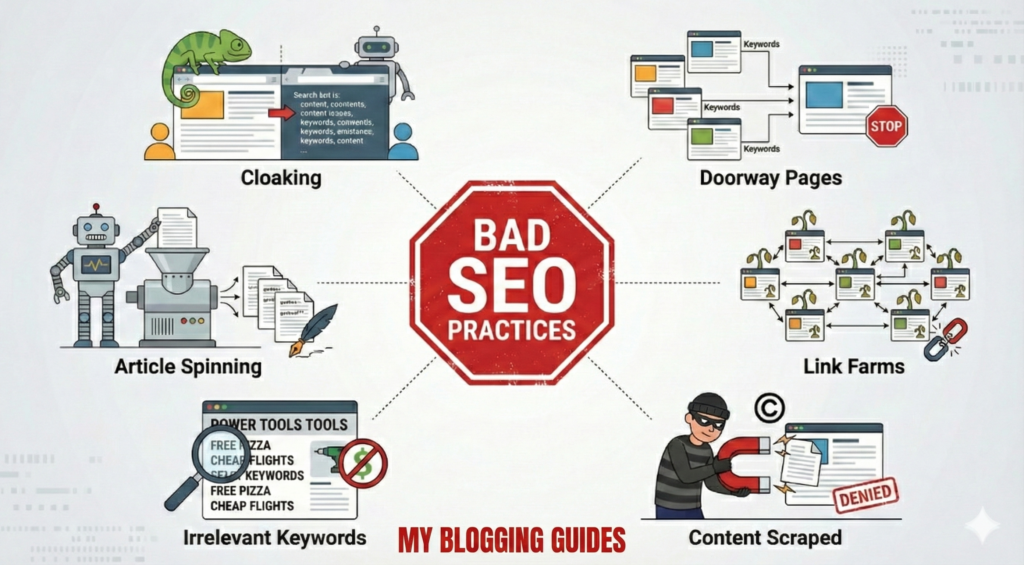
This often happens when you have a poor understanding of the latest Google updates. It can also happen if you’ve implemented black hat SEO strategies to rank websites, or you have applied cheap tactics to achieve higher rankings in a short time span.
If you do any of the following, chances are you’ll eventually be hit by a penalty and lose your rankings in Google, or you might not rank at all.
For long-term rankings, check out our SEO checklist article and focus on implementing the key steps outlined there.
The first step is to realise you’re applying bad SEO practices, which you’ve done.
Good job on that.
Let’s now see why avoiding these bad SEO practices is crucial for the longevity of your site.
Why Is Avoiding Bad SEO Tactics Crucial For Your Website?
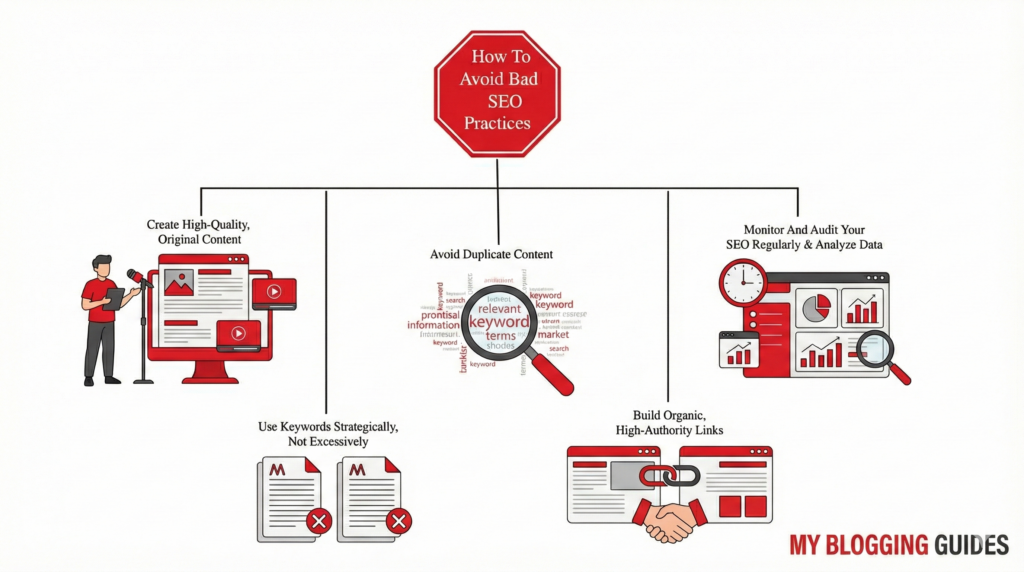
If you’re in the business of just making quick money and not offering any value to your readers and building a long-term brand and online asset, doing bad SEO practices might interest you.
If, however, you have a long-term outlook with your website and are looking to make a full-time living out of this online asset, you should follow white hat SEO tactics that will keep you in the search results for years to come.
SEO Problems And How To Avoid Them
Below, we will explore the bad SEO practices people use and how to resolve them if you’re making the same mistakes, knowingly or unknowingly.
#1. Keyword Stuffing
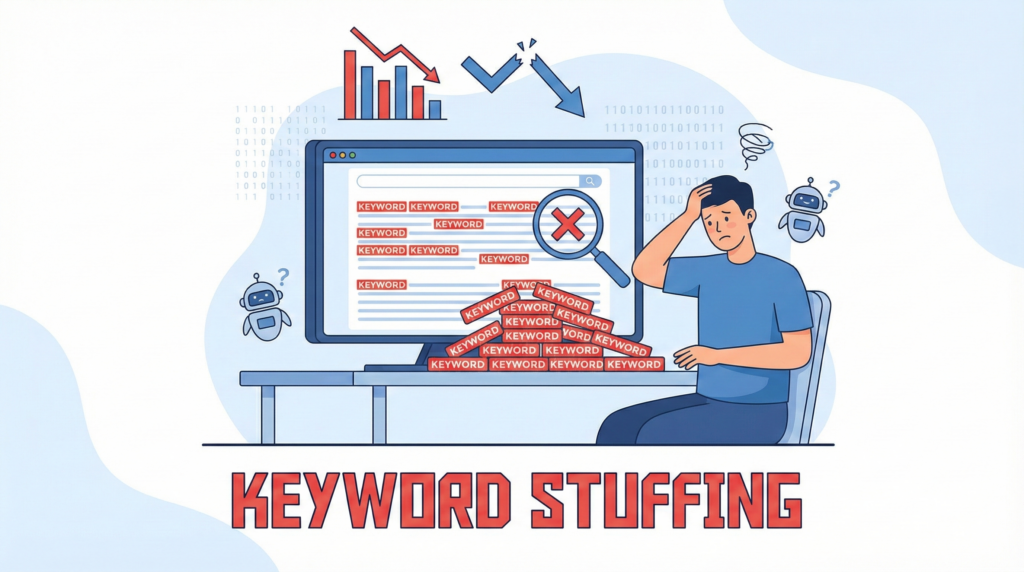
I see a common practice of keyword stuffing across most blogs online.
Bloggers think using keywords more often in an article will yield higher Google rankings; however, the opposite is true.
Overusing your keyword in the article will hamper the overall user experience, discouraging them from staying on your website longer. All of this will result in Google giving your website and rankings less importance.
In 2026, Google is smarter than you think. It can easily understand the topic of the article, so honestly, there’s no need for you to stuff keywords into it.
Keyword stuffing used to work back in 2008, but not anymore.
What’s the solution?
A very simple solution is to always use the main keyword in the first 100 words of your article and to use synonyms in the rest.
Make use of tools like ChatGPT. Ask ChatGPT to provide a list of semantic SEO keywords that you can use in the article.
Here, I have taken a brief example of the keyword “On page SEO”. Look at how well ChatGPT has given me a list of keywords that I can now use in the article without any keyword stuffing.
The goal is to create high-quality content for your readers, which will eventually improve your search rankings.
#2. Chasing Bad Quality Links
Building links isn’t a numbers game, which most bloggers chase – it’s the opposite.
Your goal is to build high-quality organic backlinks rather than getting those free and cheap directory and forum backlinks.
Many people use link farms and private blog networks (PBNs). Honestly, all those cheap tactics don’t work on Google at all in 2026. The algorithm is smart enough to catch it all and eventually tank your search rankings.
What’s the solution?
Getting one dofollow link from a high-authority website in your niche is 10 times better than acquiring 50 forum or spammy directory links.
But how?
1. Broken Links
Use tools like Screaming Frog or Ahrefs to find broken links on a reputable blog in your niche.
Reach out to them using an email outreach software like Lemlist and offer them a free content write-up in exchange for a link.
This is one of the easiest ways to get high-quality do-follow backlinks in your niche.
2. Resource Page Outreach
Many big blogs have a resource page on their websites with valuable articles attached.
Your job is to reach out to these websites and ask them if they are willing to link your article to that list.
3. Competitor Analysis
By using tools like Semrush or Ahrefs, you can easily import the list of backlinks your competitor has acquired.
You have a similar opportunity to acquire backlinks from these websites. Email them and offer a free article, podcast, or something else that adds value to their audience.
4. Engage in communities
Focus on forums like Reddit or Quora, where you’re genuinely helping users with your answers, and, if required, you can include a link to your website. However, don’t overdo it and spam cause that will work against you.
Pro Tip:
To get high-quality organic backlinks in your niche, start by building relationships. The more people know you in the industry, the higher your chances of getting free links.
#3. Publishing Low Quality Thin Content
With AI trending everywhere, users are publishing articles quickly with little to no effort.
Everyone’s trying to trick the system, which is too smart now to catch it all.
Google can easily detect copy content, AI-generated content, low-quality thin content, or unrelated content by crawling the article.
A low-quality article is not fully original, contains grammatical and spelling errors, isn’t fully formatted, and doesn’t meet the user’s search intent.
What’s the solution?
Google rewards website that focuses on solving user queries with their content. As a blogger, your primary goal should be to write articles with search intent.
The article should have no grammatical or spelling errors, avoid unnecessary keywords, and be written by a human, as fully AI-generated content compromises the article’s quality.
Here’s a plan to resolve this mistake and prevent it from happening again.
Firstly, have a proper content plan that includes researching the keywords you want to rank for on Google.
The next step is to create supporting articles around the main topic, also known as pillar pages. Furthermore, create a resource page where users can visit and learn about various issues on your website.
Consider tools like Semrush or Ahrefs to identify relevant blog topics for the website.
Creating high-quality content is a must if you want to rank and maintain your rankings on Google. Don’t choose the easy way for faster rankings, because Google will eventually catch you.
#4. Wrong Keyword Targeting
Let’s face it.
Even if you write the best article on the internet that no one is searching for online, all your efforts mean nothing.
That’s where doing the right keyword research plays a vital role. Doing the right keyword research ensures that you’re not wasting your efforts for nothing.
You’re competing against the big publications that have thousands of dollars to spend on ranking for high competition keywords. If you do your keyword research right, you’ll stand out from the crowd. Doing this enables you to rank for long-tail keywords without spending a fortune on ranking.
What’s the solution?
Let’s understand how you can do the right keyword research and find low competition long tail keywords to target with the help of Semrush Keyword Magic Tool.
Head over to this link and try the tool for free.
In this example, I’ve used the seed phrase “YouTube SEO,” and as you can see, Semrush shows broad match keywords.
The biggest advantage of using the tool is the ability to gauge keyword difficulty. You now exactly know what keywords to target and what to avoid.
#5. Ignoring Website Issues
Most of us focus only on ranking and never really care about the internal issues our website is already facing.
SEO is not just about rankings. You need to focus on technical SEO, run site audits, implement proper on-page SEO, and prioritize user retention to rank at the top of Google search results.
Technical SEO improves your website’s crawlability.
Websites with properly implemented technical SEO are more likely to rank because search engine bots can easily crawl their sites.
If you avoid this site, this thing alone can hinder your rankings, or worse, it might not even index your webpages.
What’s the solution?
The easy solution for non-techy people like you and me is to use the Semrush Site Audit Tool available here.
Put your domain in the search box and let Semrush do its magic. The site audit will take about 5 minutes to run.
Once done, click all the issues on your site and start resolving them. Semrush gives you crawlability, site performance, internal linking, and markup percentages.
On the right side, you’ll see all the issues your site currently has.
Focus on the highest number of errors to resolve first; that may be hindering your search rankings.
#6. Weak Internal Linking
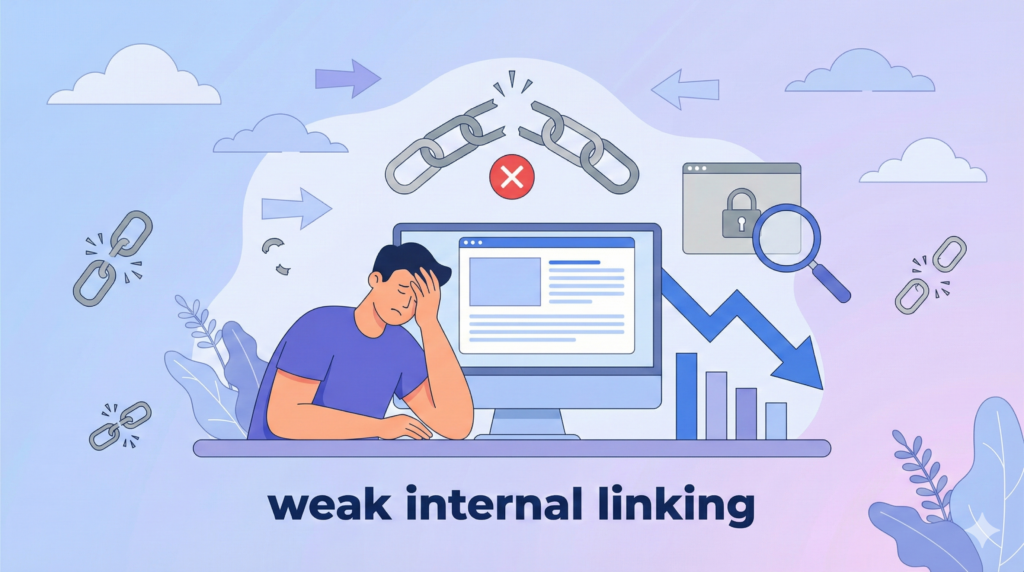
Internal linking is a natural process that should happen when writing articles and sub-articles.
You must have noticed that we use many internal links in our articles that are closely related to each other.
Internal linking helps search engine bots crawl your content more effectively and index pages faster. It also helps readers find and read more content on your website, thereby increasing the time they spend on your site.
Unfortunately, most website owners and bloggers never take internal linking seriously and later suffer the consequences.
But not anymore, here’s a full solution to the bad internal linking SEO problem.
What’s the solution?
In the last step, we already ran an SEO audit for free on Semrush.
That’s the first step. The next step is to click on the internal linking tab from that report.
In the internal linking tab, you’ll find opportunities to improve internal links on the website. Semrush will show you broken links, malformed links, orphaned sitemap pages, and pages with fewer than 1 internal link.
Focus on the highest-traffic pages and improve their internal linking structure to pass link juice to other pages.
#7. Keyword Cannibalization
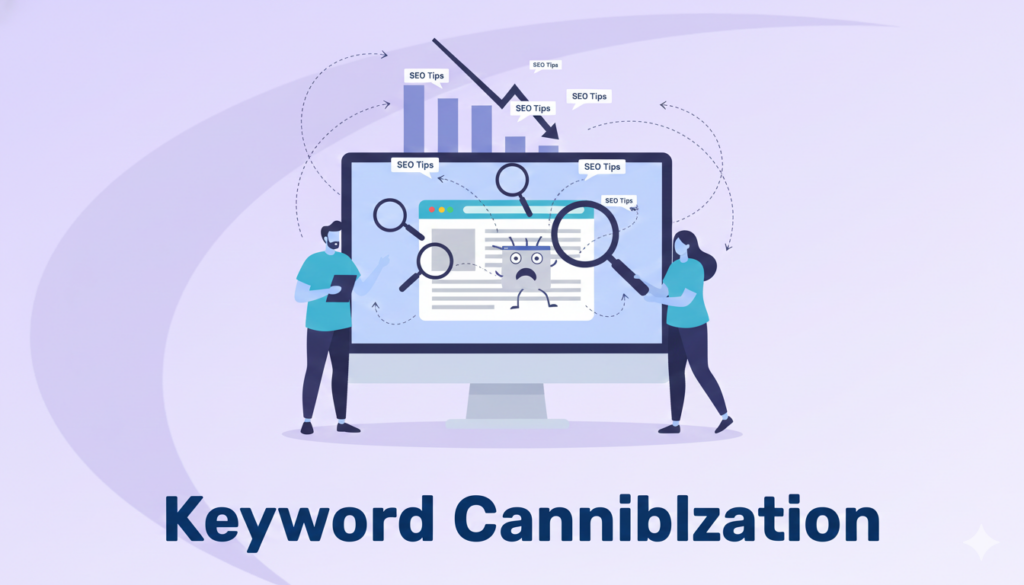
A lot of you don’t know that multiple articles on your website are trying to rank for the same keyword, aka keyword cannibalization.
If this is the case, you’re seriously wasting a lot of your time and effort on building your blog. Keyword cannibalization is a serious issue that needs to be resolved quickly.
It confuses Google about which page is trying to rank for a given keyword when multiple pages are competing for the same keyword.
What’s the solution?
As always, Semrush will make your job easy.
If you don’t have access to any tools, the best way possible for keyword cannibalization is to merge both articles into one article or repurpose both articles into one new article.
Doing this simple activity will help Google rank you for one page.
Now, let’s understand it with Semrush. In reports, you have the position tracking report; click cannibalization.
Now you can see where cannibalization is occurring: on pages or on keywords. Once you figure that out, you can start resolving the issue.
#8. Avoiding Mobile Optimization & Page Speed
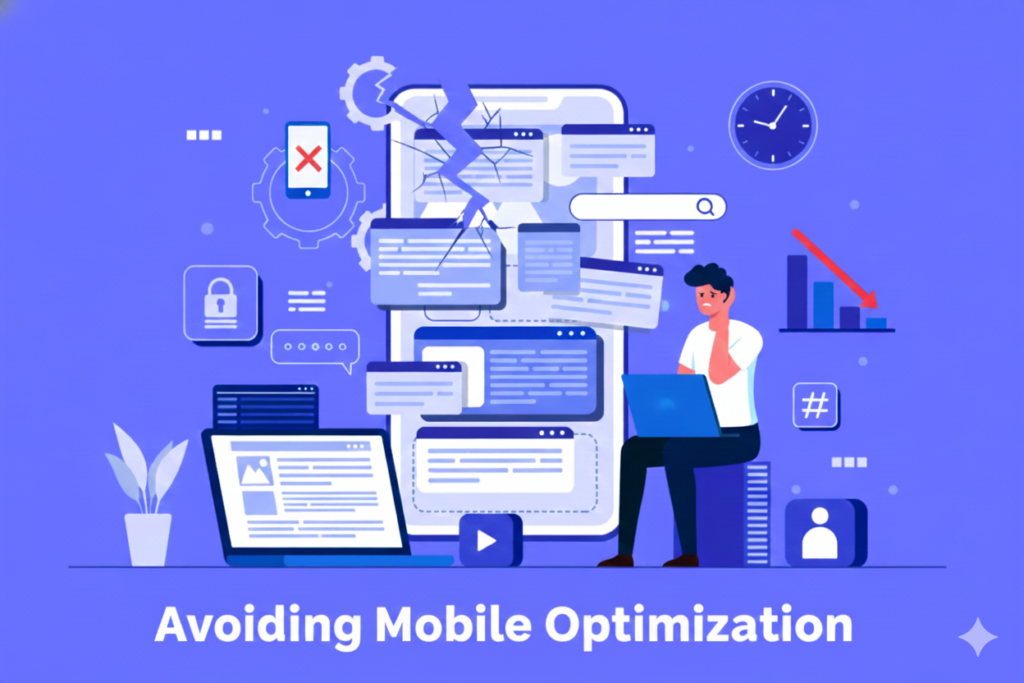
More than 90% of the traffic you receive on your website comes from mobile. Ignoring mobile optimization can harm you big time.
It’s a must to have a website that’s fully mobile optimized.
Google has officially said that it considers mobile-friendly websites higher in search results than websites that aren’t mobile-optimized.
With most traffic coming from mobile devices, if your website isn’t mobile-optimized, expect lower user retention and very high bounce rates.
Most shopping these days is done on mobile phones; people also read articles and watch videos on them.
Mobile optimization should be your number one priority if it’s not already. But how? Let’s find out.
What’s the solution?
First, head over to the PageSpeed Insights website on Google and enter your domain. Next, wait for it to analyse your website.
Once done, look for all the errors it shows. Now start working on those errors, cause the website also shows you the solutions.
Generally, while optimizing for mobile devices, focus on responsive design and touch navigation.
#9. Ignoring Short URLs
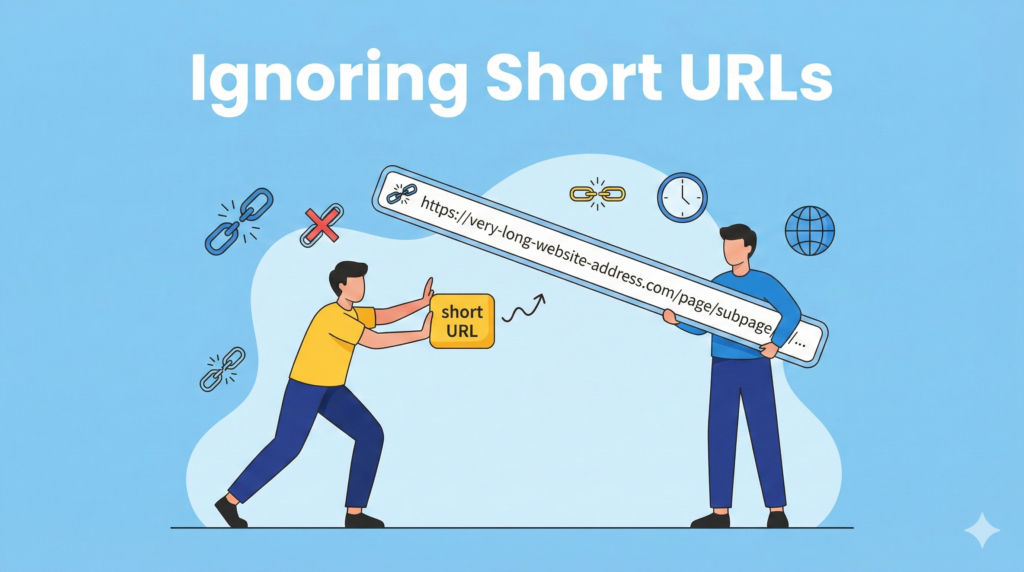
I see a lot of newbie website owners and bloggers never care about optimizing website URLs.
Long URLs hamper your SEO performance by providing a poor user experience, which is directly correlated with SEO rankings.
An unoptimised URL can hinder readability, be low in keyword relevance, and cause navigation difficulties.
What’s the solution?
Let’s understand how you can go from bad URLs on your website to good URLs.
First, keep your URLs short and easy to read. Next, use your main target keywords in the URL. Never use dynamic URLs if you’re running a blog.
Here’s an example of a bad and a good URL
Bad URL: xyz.com/blog?id=249
Good URL: xyz.com/blog/seo-problems
SEO Problems FAQs
Let’s cover all the questions people have related to SEO problems in this section.
Question: What are some common SEO mistakes?
Avoiding long-tail keywords, writing low-quality, thin content, focusing on paid links rather than organic outreach, and not prioritising page speed and mobile optimization.
For example, if you avoid targeting long-tail keywords, you’re missing out on all the low-hanging fruit that can yield you higher rankings and make you money.
Question: What is considered a bad SEO practice?
Implementing black hat SEO is considered to be a bad SEO practice.
Using link farms and private blog networks to trick Google is not healthy for your website. Moreover, cloaking and buying cheap links in bulk are also considered bad practices.
Question: Which is a bad SEO practice?
The most harmful and also the common one is keyword stuffing. Other issues include poor internal linking, zero mobile optimization and page speed, keyword cannibalization, and non-working technical SEO.
Question: What type of SEO should always be avoided?
Anything that is trying to trick the algorithm for faster rankings. Both black- and grey-hat SEO techniques should be avoided entirely, because you’ll lose more than you gain from them.
Final Words
Addressing these bad SEO practices takes effort, and not everyone is willing to put in that work. If you put in the work, the results will speak for themselves.
The tips I have shared with you will definitely boost your search rankings once you work on the problems.
I hope you liked this article, and if you have any suggestions for me, please don’t hesitate to share them with me in the comments below.
Also, tell me what bad SEO practices you are working on immediately after reading the article.
Thank you for reading all the way till here. I’ll see you in the next information-packed article.
Contents
