
11 Tips To Improve Your Ranking On Google (SEO Guide)
Launching a website is easy; however, ranking your website on Google is tough.
Writing content and waiting for some magic to happen isn’t going to work at all in your favour.
Ranking on Google requires a deep understanding of SEO, content, and website structure.
In this article, we will cover exactly how to rank higher on Google with the right strategies to maintain your rankings for the long term.
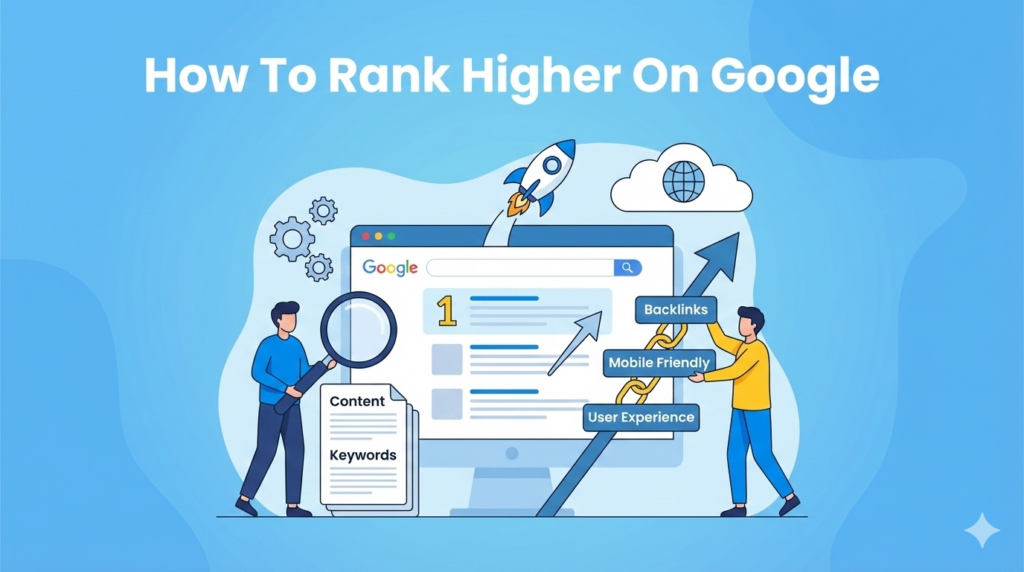
So without wasting any further time, let’s dive straight into the article and learn the best strategies for higher ranking in Google and LLMs like ChatGPT and Gemini.
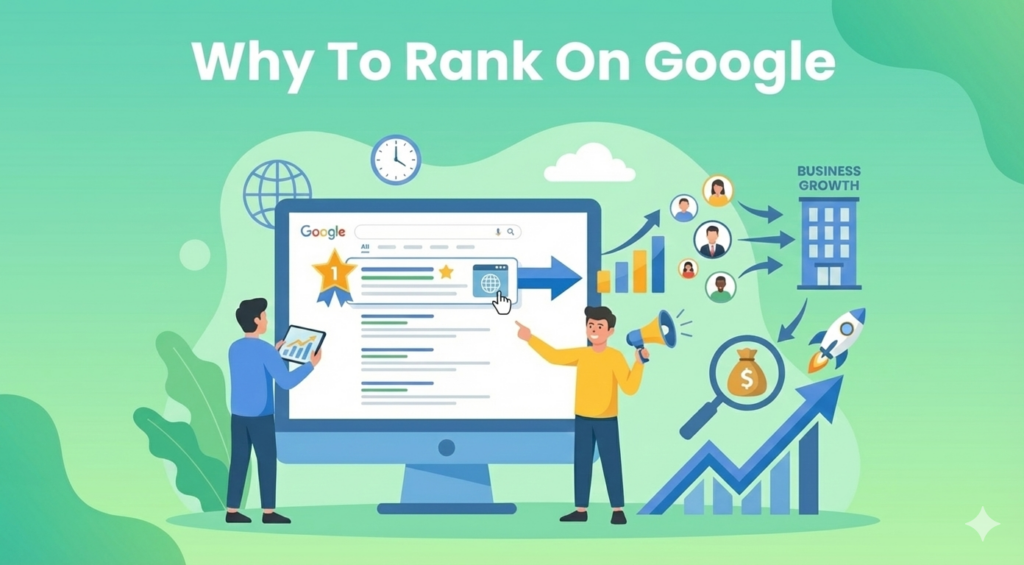
Why Is It Even Important To Rank Higher On Google?
Before you make all these efforts to rank on Google, it’s essential to understand what the benefits of ranking higher in the search results are.
Here are a few reasons that will definitely entice you to work towards ranking higher on Google. Let’s begin.
#1. Free Organic Traffic
The number one reason why people want to rank on Google is the potential to get high-quality organic traffic for free.
Free, targeted organic traffic converts well. A report by FirstPageSage suggests that ranking in the 1st position on Google yields a 39.8% CTR, which is double that of the 2nd position.
#2. Audience Trust
If asked to choose between a paid advertisement and an organic search result, most users prefer the organic result.
Why?
As end-user awareness increases, they know that most paid advertisements are not worth clicking. However, an organic search result is exactly what they are looking for in the first place.
#3. Cost-Effective Marketing
SEO is basically free marketing for your website, unlike paid search. With paid search, you’re paying Google or Bing a fee whenever anybody clicks on the ads.
Hence, for beginners and even intermediates, SEO becomes the number one way to rank higher on Google without putting a hole in your pocket.
#4. Long Term Growth
Let me be honest. SEO or ranking on Google isn’t a one-day thing. This Ahrefs study suggests you need 3 to 6 months of effort before you see significant SEO results.
If you stick with the process of writing the highest quality content, building the best backlinks, and optimizing your website, you have what it takes to get long-term growth from SEO.
#5. Competitive Advantage
The last reason to rank higher on Google is to get a clear competitive advantage over your competitors. As discussed above, most clicks go to the top-ranked results on Google.
How Does Google Search Ranking Work?
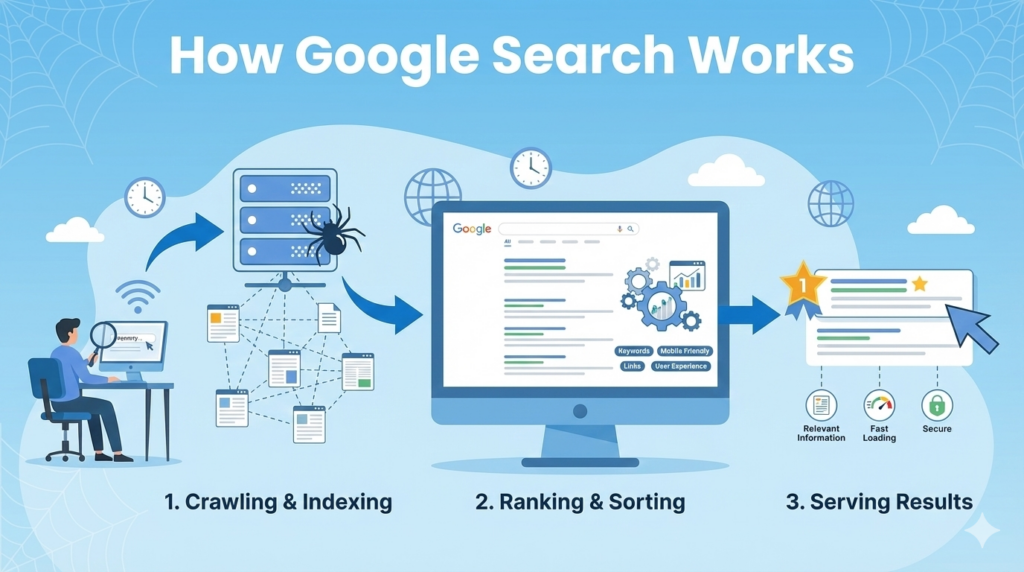
Let’s briefly understand how Google search ranking works, which is divided into 3 main aspects.
#1. Crawling
It’s the discovery phase, where the Google bot scans the entire web to find new pages. These bots then analyse the content.
#2. Indexing
This step comes after crawling. Indexing is the process by which Google adds your web page to its search results. The bot reads the keywords you’re targeting, the content’s relevance, and its freshness.
#3. Ranking
The final step is to rank your newly indexed webpage on Google. However, you won’t immediately rank in the first position. You have to work towards it, which will be covered in the next section of the article.
How To Improve Google Search Rankings?
Google determines where to rank a website by fulfilling all the following criteria.
– Quality Content: Does your website consist of high-quality, informative content?
– User Experience: Do you offer the best user experience whenever a user visits the website?
– Schema Markup: Have you implemented schema markup for the crawler to understand your website content better?
– Technical SEO: Does your website load fast on mobile and is crawlable?
– Backlinks: Do other websites relevant to your niche link to your content? If yes, how often?
– Social/Brand Signals: How many social shares do you get online, and how many users search for your brand name on Google?
There are many other factors that Google considers when ranking your website; however, if you focus on the ones discussed above, you can easily outpace your competition.
Now, let’s look at each of these factors in more detail so you get a clear picture of what you need to do on your end to improve search rankings.
#1. Writing High-Quality Long Form Content
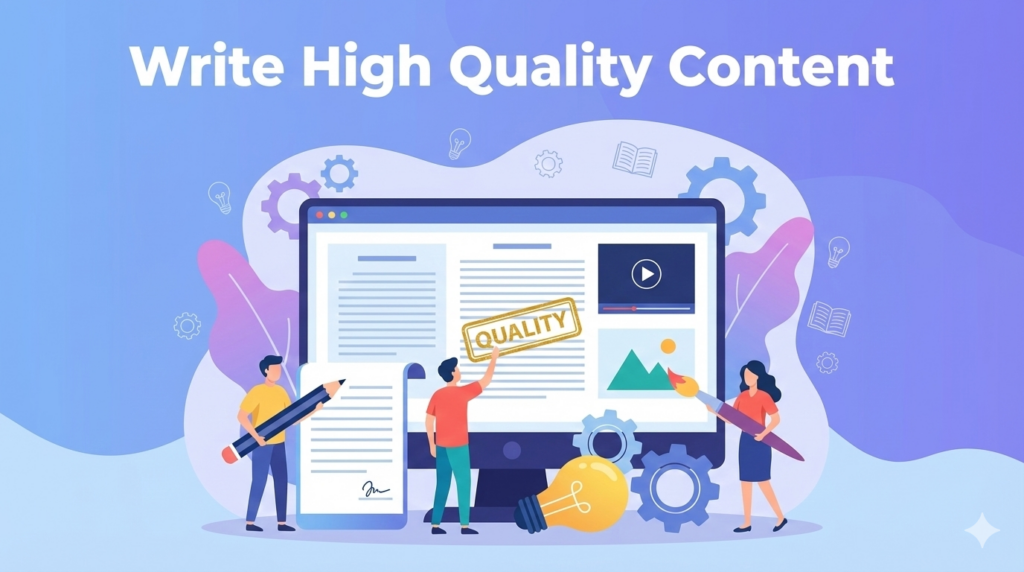
Recently, we covered in our article about the perfect blog post length that writing long-form, high-quality content can seriously help your Google rankings.
However, don’t just write long, fluff-filled content that offers no real value to the end user.
By high-quality, I mean cover research, showcase studies, and cover everything under the sun about that particular topic. Make it the best article available on the internet for that topic.
Use multimedia like images, videos, and infographics. Ignore AI written articles because they will do more harm than good.
Article length also depends on the type of content topic you’re covering. Complex listicles or advanced case studies can be supported by articles ranging from 2000 to 3000 words. On the flip side, if you’re covering news articles or trend-based articles, they hardly range from 500-700 words.
#2. Targeting The Right Keywords
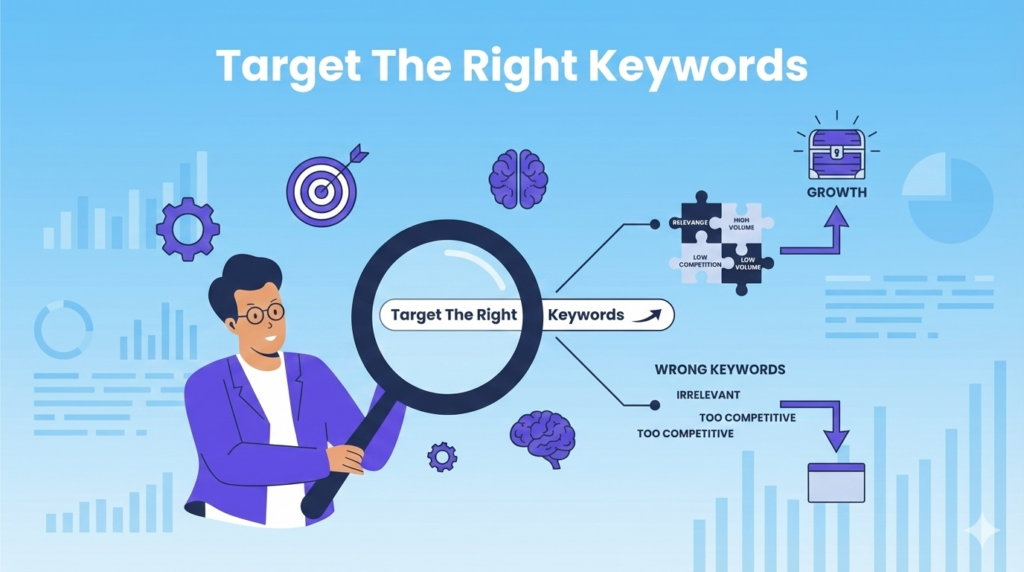
Targeting the wrong keyword can break you and your SEO efforts. Everyone wants to rank for the highest-volume, most competitive keyword.
I call it wishful thinking. Do you want to satisfy your ego or do you wanna make money?
If you wanna make money, definitely focus on long-tail, low-effort keywords that rank more easily than one-word keywords.
Ranking for the keyword “backlink” is almost impossible compared to ranking for keywords like “what are backlinks”, “how to build backlinks“, and “should we buy backlinks”. If you cover all these questions in detail, you have a much higher chance of ranking for these keywords.
#3. Update Your Content Regularly

Google loves freshness. The algorithm hates articles that aren’t updated for ages.
If you’re someone who writes an article and never cares to bother about it again, you’ll never rank higher on Google. As a blogger or website owner, your job is to update these articles with fresh information constantly.
The best way to keep up with this activity is to track your best-performing pages using tools like Semrush or Ahrefs, and update them regularly.
You can update headlines, meta descriptions, and add new internal links. Moreover, you can also keep a check on your competitor and see what topics they have covered that you have missed – cover all these topics.
#4. Focusing On Users’ Search Intent
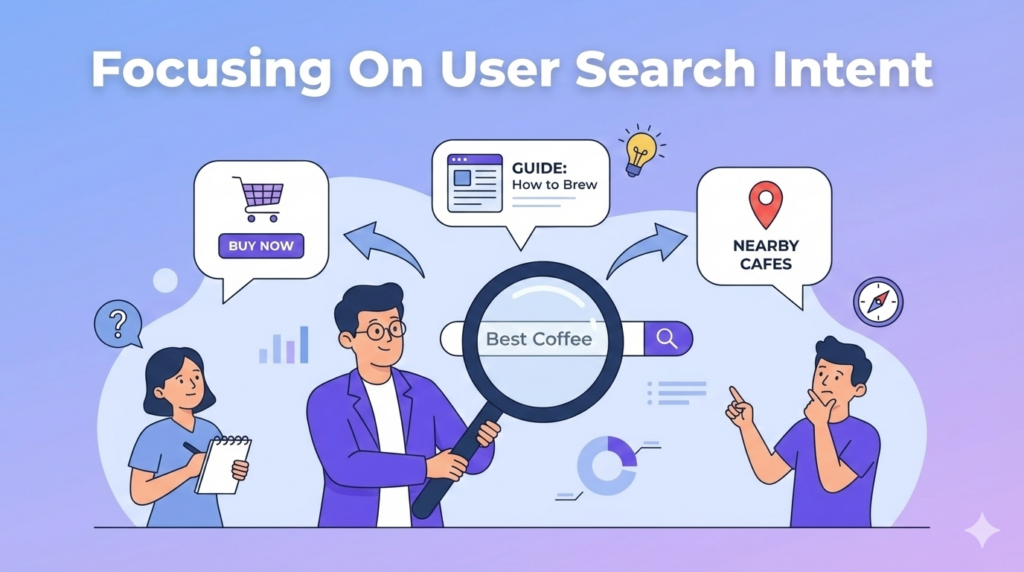
A key ranking factor in the Google search algorithm is to match the user’s search intent. Search intent is understanding what the user is trying to achieve with their search query.
Every search query is different; some users are trying to buy something online, whereas others are looking for an answer. Your job is to understand the exact reason behind their search.
Let’s understand this with an example.
Let me search for “best wordpress plugins for ecommerce” and see what shows up.
As you can see in the screenshot, Google is showing me list-based articles. Here, Google thinks the right content to show is listicles.
Next example, let’s search for “make chocolate cupcakes”. Here, Google is presenting a list of video tutorials that teach you how to make cupcakes.
Notice how the results change with the type of search query you fire. Understand whether the user is seeking information or looking to buy something, and tailor your content accordingly.
#5. Website Load Speed

Google has officially announced that page speed is a ranking factor. Page speed is also a part of the Core Web Vitals.
The algorithm analyzes various elements of your website, including the load times of different components and fonts, as well as overall responsiveness.
To check your site speed, you can make use of the free tool known as Pingdom.
Enter your domain name and select the server. Wait for it to show you the reports.
Scroll down to see what needs improvement and much more data about your website.
Another good tool by Google itself is the Page Speed Insights. The good part about this tool is that it shows you website performance metrics and load times for both mobile and desktop.
Quick Tip: An easy way to improve your WordPress website load times is to install a CDN. A Content Delivery Network like Cloudflare can significantly improve your website load times.
#6. Mobile Friendly Website

Believe it or not, more than 90% of the traffic comes from mobile devices these days.
Google began prioritizing mobile-friendly websites in 2019. Google uses your mobile pages for crawling and indexing instead of the desktop pages.
For a mobile-friendly website, install a theme that’s compatible with mobile devices. Furthermore, write content in short, easy-to-read paragraphs for mobile devices.
With over 4.2 billion active mobile internet users, please don’t ignore a mobile-friendly website.
#6. Build High Quality Backlinks
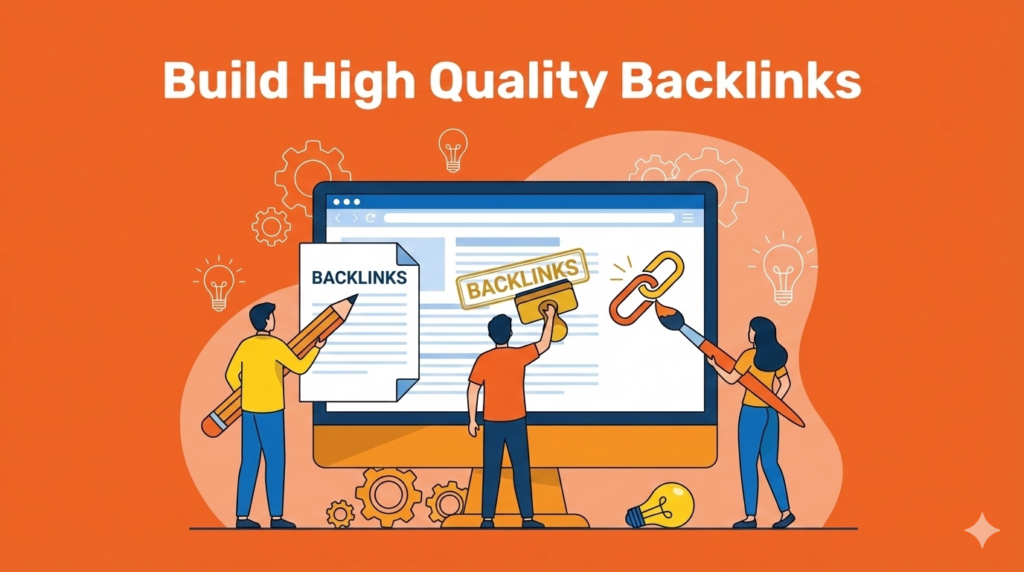
We recently covered an in-depth article on how to build backlinks the right way without being spammy.
I’ll still give a brief overview of how backlinks help you rank higher on Google. Incoming links to your domain from an authority website in your niche are a vote that you earn for ranking higher.
The more such votes you collect, the higher your chances of ranking at the top of SERPs.
A study shows that fewer backlinks lead to lower rankings and, hence, attract less organic traffic.
Please don’t confuse more backlinks equals higher rankings. Building backlinks is more about quality than quantity. Ten good backlinks are more powerful than 100 bad links.
Guest blogging and identifying broken link opportunities are among the best and safest ways to build backlinks. You can also gather links by appearing on podcasts or by promoting your website on social platforms or forum websites.
#7. Website Security

Security plays a huge role in helping users build trust in your website.
Also, Google has officially announced that websites with HTTPS will be ranked higher than those with HTTP.
As you can see, our website is also HTTPS secured.
Securing a website is easy these days. Go to your hosting provider’s backend and log in to CPanel.
Search for an SSL certificate and install it for absolutely free. You’ll get a secure HTTPS connection within 24 hrs.
If you don’t want to get into the technicalities, I’d suggest installing a free WordPress plugin like Really Simple Security and letting it handle the heavy lifting for you.
Secure website URL example: https://www.example.com
Insecure website URL example: http://www.example.com
Google will never promote insecure websites in SERPs, as they pose a risk to end users compared to secure websites.
#8. Fix Broken Links & Redirects

Broken links and 301 redirects can harm your website more than you can imagine.
404 broken links occur when you give outbound links, and that links are no longer working. Google treats this as a bad sign.
To solve this, you can use tools like Semrush and Ahrefs to find the full list of web pages that are 404 redirects and remove or replace those links.
Another issue is the 301 redirect. Webpages that were originally going to domain A are now redirecting from domain A to domain B, for example.
Again, you can use Semrush to find a set of these websites and unlink them to keep your outbound link profile clean and healthy.
Broken links and 301 redirects create a bad user experience, like slower load times and increased crawl time; these smaller issues over time lead to poor usability and crawlability that can harm your rankings.
A bad user experience signals to Google that you don’t manage your site well.
#9. Focus On On-Page SEO
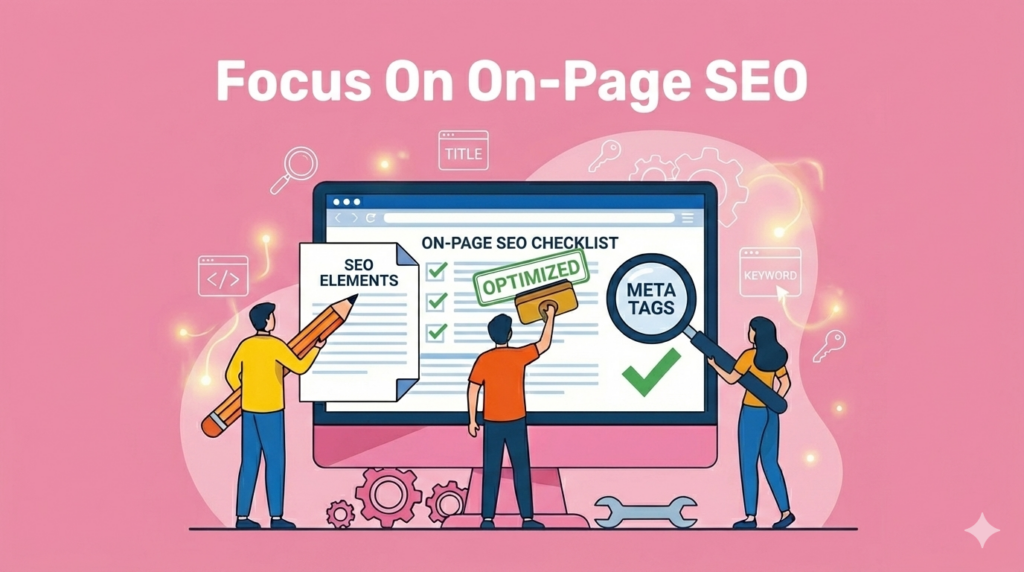
We have an in-depth article on On-Page SEO on our website that you can read here.
Briefly maintaining on-page SEO is crucial for your website. On-page SEO consists of many things, like:
– Having a clean and short URL.
– Giving alt texts to images and videos.
– Avoid keyword stuffing
– Add table of contents
– Do proper internal linking
– Optimise headings and subheadings
– Write better meta descriptions
and more
This is just a gist of on-page SEO. To see the full checklist, I’d highly suggest you read our article, which covers everything with practical examples.
#10. Focus On User Experience

User experience is the most underrated yet very important ranking factor for achieving top Google search results.
You must be thinking, but how does Google understand user experience?
Well, by multiple things, let’s understand how.
#1. Click Through Rate (CTR)
CTR is calculated as the number of users who click on your website after performing a search query divided by the total number of users who perform a search query. Attention-grabbing titles and meta descriptions play a real role in boosting CTR.
For example, if a website ranking at number three gets 50% of the clicks, number two gets 20%, and number one gets 30%, chances are the number three website will be pushed to number one pretty soon.
#2. Bounce Rate
Bounce Rate is how much time a user spends on your website after clicking on the website from a search. Bounce rate can be reduced by interlinking related articles so users visit more pages and spend more time on the website.
If a user visits a specific webpage and bounces off in seconds, it sends a bad signal to Google that the following website isn’t worth the rank it currently has.
#3. Dwell Time
Dwell time is very similar to bounce rate, but not exactly. The longer the dwell time, the stronger the user engagement signals you send to the algorithm.
The best way to increase dwell time is to write practical case studies and how-to articles that readers love to read.
#11. Website Structure
Most website owners completely ignore the website structure.
If you’re someone who has recently started a website and hasn’t implemented the right structure, trust me, my friend, you’re going to regret it big time in the future.
Having the right website structure helps Google bots to crawl and index the website efficiently. To help with that, you must have a well-implemented sitemap witha robots.txt file installed on the website.
An XML sitemap is very crucial for having a clean website structure. Whenever new content is published, the bots will quickly crawl it using a sitemap and index your pages.
Use WordPress plugins like Yoast SEO or the All in One SEO plugin to create a sitemap in less than 5 minutes.
Frequently Asked Questions (FAQs)
Let’s cover some common questions users have about ranking high on Google.
Question: How long does it take to rank on Google?
Ranking on Google isn’t an easy pill to swallow. If you put in consistent effort and target the right keywords that are moderate to easy to rank for, you can rank in 3 to 6 months. However, ranking is subjective and depends highly on the niche you’re in and also on the keyword you’re looking to target.
Question: Can I pay money to Google for ranking higher?
Absolutely not.
You shouldn’t, and you cannot pay Google to rank your site high. All you can do is use the tips and tricks I shared with you in this article and patiently work on your website for 6-12 months. You’ll start seeing good results automatically without paying anyone.
Question: How do I index my webpages quickly in Google?
To index your pages faster on Google, ensure that a properly configured sitemap and robots.txt file are installed on your website.
Doing this helps crawlers receive the fresh content as soon as it’s published and index it in Google.
Question: How to rank #1 on Google?
The simple answer to this question is to follow the strategies shared in this video.
Focus on building a good backlink profile with the help of guest blogging, have a good website structure, focus on implementing on-page SEO, and improve website load times.
Doing all of the above gives you a fair chance of ranking at the number 1 spot in SERPs.
Question: Why are my Google rankings always low?
Simply because you’re not doing the right things that matter, if your website lacks quality content, has low-quality links, higher website load times, unoptimized title tags and headings, technical issues, and low domain authority, chances of ranking become very slim.
Question: How to appear above competitors on Google?
Do things better than your competitor.
If they have written an article 3000 words long, you need to write a 4000-word high-quality article. If they have added videos and infographics, you need to do the same, but better.
Bring a fresh perspective, and Google will reward you for your efforts.
Final Words
That was it about how to rank higher on Google.
Believe me, ranking on Google isn’t easy anymore; however, if you implement everything I have shared in this article, you will give yourself the best shot at reaching the top of the search results.
I have literally shared what has worked for me over the years without hiding anything. I have made this a one-stop answer to all your queries about ranking at the top of Google search results.
If you have read the full article, do leave a comment down below and let me know your three biggest learnings from this article.
I’ll see you in the next one.
Contents
